
Anja Musura is a young Croatian artist raised in Canada whose practice investigates what she describes as “the unseen within the seen” — the translation of light, sound, and energy into visual form. Working through an intuitive, synesthetic process, she experiences sound as visceral force and acts as a conduit through which this energy enters […]
Anja Musura is a young Croatian artist raised in Canada whose practice investigates what she describes as “the unseen within the seen” — the translation of light, sound, and energy into visual form. Working through an intuitive, synesthetic process, she experiences sound as visceral force and acts as a conduit through which this energy enters […]
Anja Musura is a young Croatian artist raised in Canada whose practice investigates what she describes as “the unseen within the seen” — the translation of light, sound, and energy into visual form. Working through an intuitive, synesthetic process, she experiences sound as visceral force and acts as a conduit through which this energy enters space as image. Music and field recordings guide her into a meditative state of flow, where inner cues become precise and the work emerges as a refined placement of energy rather than representation.
Her minimal, high-contrast palette reflects this pursuit of purity. Reduction becomes a method of clarity: chaos is distilled, noise removed, leaving space for light and sound to exist in concentrated form. The resulting works hover between meditation and tension — dreamlike yet charged — inviting viewers into an energetic encounter that can evoke introspection, confrontation, escapism, or stillness. For Musura, creation is both mirror and meditation: a refining of chaos into balance, and an optimistic study of resilience through light.
Your work often investigates “the unseen within the seen.” Could you elaborate on what that means to you, particularly in relation to light, sound, and energy?
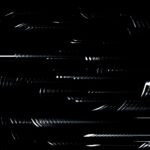
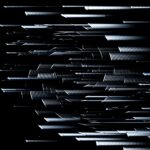
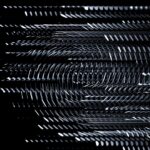
Light and sound have pure energy that can be felt and intuitively perceived. I tune into the energy of each and refine it into a visual format. It is a synesthetic process of seeing sound, experiencing light and sound as an intense, visceral energy, and acting as a conduit for that energy to enter into space as images.
Intuition and synesthetic processes are central to your approach. How do you access or interpret these inner cues when working?
I enter into a state of flow by listening to music or sounds. In this meditative state, the intuitive energy is clear and precise – it enters into existence, and I am the conduit to place it.
You work with a minimal colour palette and strong spatial awareness. How do you see reduction and restraint contributing to the emotional or energetic effect of your pieces?
The high contrast, minimalist palette is a reflection of the energy of light and sound. The restraint in color and objects invite the viewer into the pure energy of light and sound. To refine is to make the image pure. The chaos enters and is organized into pure form – the noise removed to make space for the clarity of the image floating in it.
Your pieces often evoke a dreamlike or meditative atmosphere, yet with a sense of tension or energy. Do you see your work as offering a form of escape, or rather a confrontation with the self?
Thank you. My intent is to include space for the viewer to be invited into the energy of the works. The sound enters as energy and I act as the vessel to place it into visual format. The pieces are an invitation into the energy of the sound and image and a reflection into the viewer’s own experience. In this, they exist in a constant state of flux and evoke an ephemeral, continuously evolving state. In the viewer, they can evoke a feeling of escapism, introspection, meditation, confrontation – a dreamlike or chaotic feeling.
Are there artists, thinkers, or personal experiences that have had a significant influence on your artistic direction?
I am into innovative approaches, experimental processes, a balance of chaos and stillness, technique that is sound, and dreamlike, immersive, escapist creative works that connect to the depth of human experience. Jenny Holzer – especially Truisms, Marina Abramovič, Moss Icon – conceptual, atmospheric, meditative, James Blake, Kelly Lee Owens, St. Vincent – innovative and refined. I like Swans. I like metal and techno and noise, Sufjan Stevens, Radiohead. I like experimental, James Blake, Radiohead for their experimental and expansive collection of sounds – if you’ve heard it, it’s probably in a Radiohead song. I like Kelly Lee Owens, techno, metal. I like St. Vincent, she balances stillness and chaos well. My practice is a reflection of my identity and experience. It is a mirror. To create is meditative and a way that I connect to and interpret the world around me and process my experience. There is an optimism, a balance, a refining of chaos.
For your exhibition Sonic Resonance you translate sound into visual and spatial form. What was your process for selecting and working with field recordings from Berlin?
I collected sounds that resonated – atmospheric, ephemeral, intense. In a meditative practice, I stared at the sky and clouds – I listened to the trees. I listened to the wind – to sound it carries, echoes, amplifies, swallows. I listened to nuance – the sounds existing in between echoes and noise, pure or distorted. If it evoked a dreamlike state or a feeling, I recorded it. In a synesthetic process, I refined the sounds I connected to into visuals. I recorded sounds.
The installation ECLIPSE, included in the show, creates a distinct sensory threshold within the exhibition. What inspired this work, and what kind of experience do you hope it opens for viewers?
The mirror as an object can be viewed as a reflection of identity and one’s experience of existence. There is violence in existence and there is stillness and optimism. Each piece of it enters a new state as it is smashed. It is broken into many pieces, abstracted into shape and refracted light. It retains and collects beauty in its ephemeral form. A meditation on resilience – the violence applied to the object transforms into pure light, expanding onto all it touches. The mirror, regardless of how much you break it, continues to reflect light and presence. It creates balanced, abstracted pieces, becoming ethereal. The light retains its intensity and reflective qualities. It is an ode to and a reflection of a continuous state of flux – the beauty in it. The violence of chaos is transformed into pure light.
You developed this body of work over a year-long residency at LCG_ARTLAB. How did that extended time influence your process and thinking?
I felt completely immersed in the environment. And my work reflects it.