
elle p. (Petra Gregorovic) is an interdisciplinary artist born in Bratislava, Slovakia, working across music, performance and new media. She graduated from the Academy of Fine Arts in Munich in 2005, following her studies at the Faculty of Humanities and Philosophy in Palermo, Italy, in 1999. Since moving to Berlin in 2005, she has maintained an active artistic and musical practice and is currently based in Potsdam. Her work has been presented at institutions, galleries and festivals across Germany and internationally, including the Städtische Galerie im Lenbachhaus in Munich, Berlin Art Week, Transmediale in Berlin, Millerntor Gallery in Hamburg and The Lovelace in Munich. She has also released music on labels such as Souvenir Music, Snowhite Records, Beats in Space Records and Cocoon Recordings.
elle p. (Petra Gregorovic) is an interdisciplinary artist born in Bratislava, Slovakia, working across music, performance and new media. She graduated from the Academy of Fine Arts in Munich in 2005, following her studies at the Faculty of Humanities and Philosophy in Palermo, Italy, in 1999. Since moving to Berlin in 2005, she has maintained an active artistic and musical practice and is currently based in Potsdam. Her work has been presented at institutions, galleries and festivals across Germany and internationally, including the Städtische Galerie im Lenbachhaus in Munich, Berlin Art Week, Transmediale in Berlin, Millerntor Gallery in Hamburg and The Lovelace in Munich. She has also released music on labels such as Souvenir Music, Snowhite Records, Beats in Space Records and Cocoon Recordings.
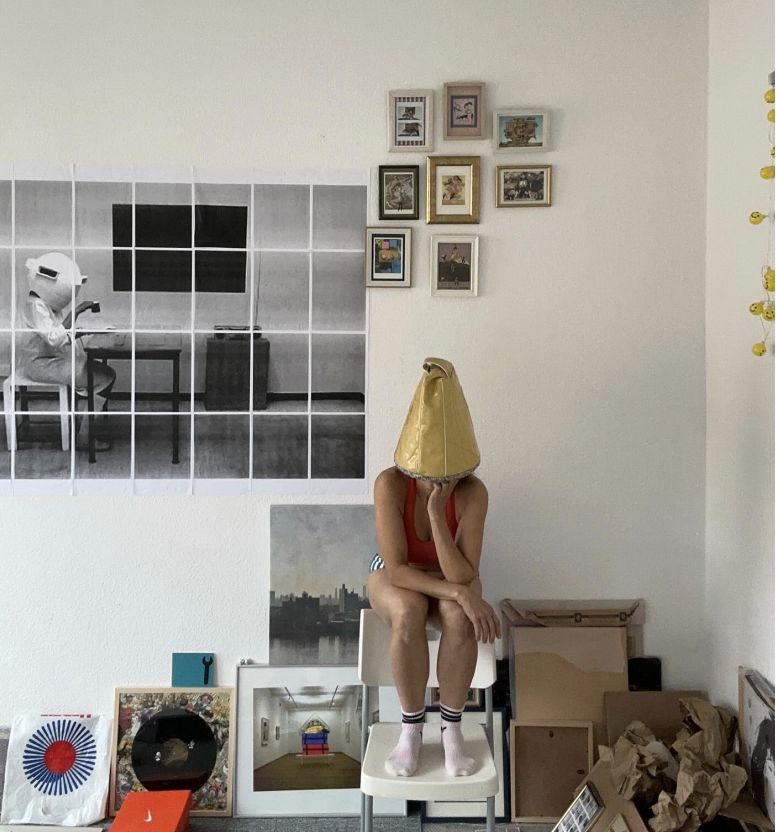
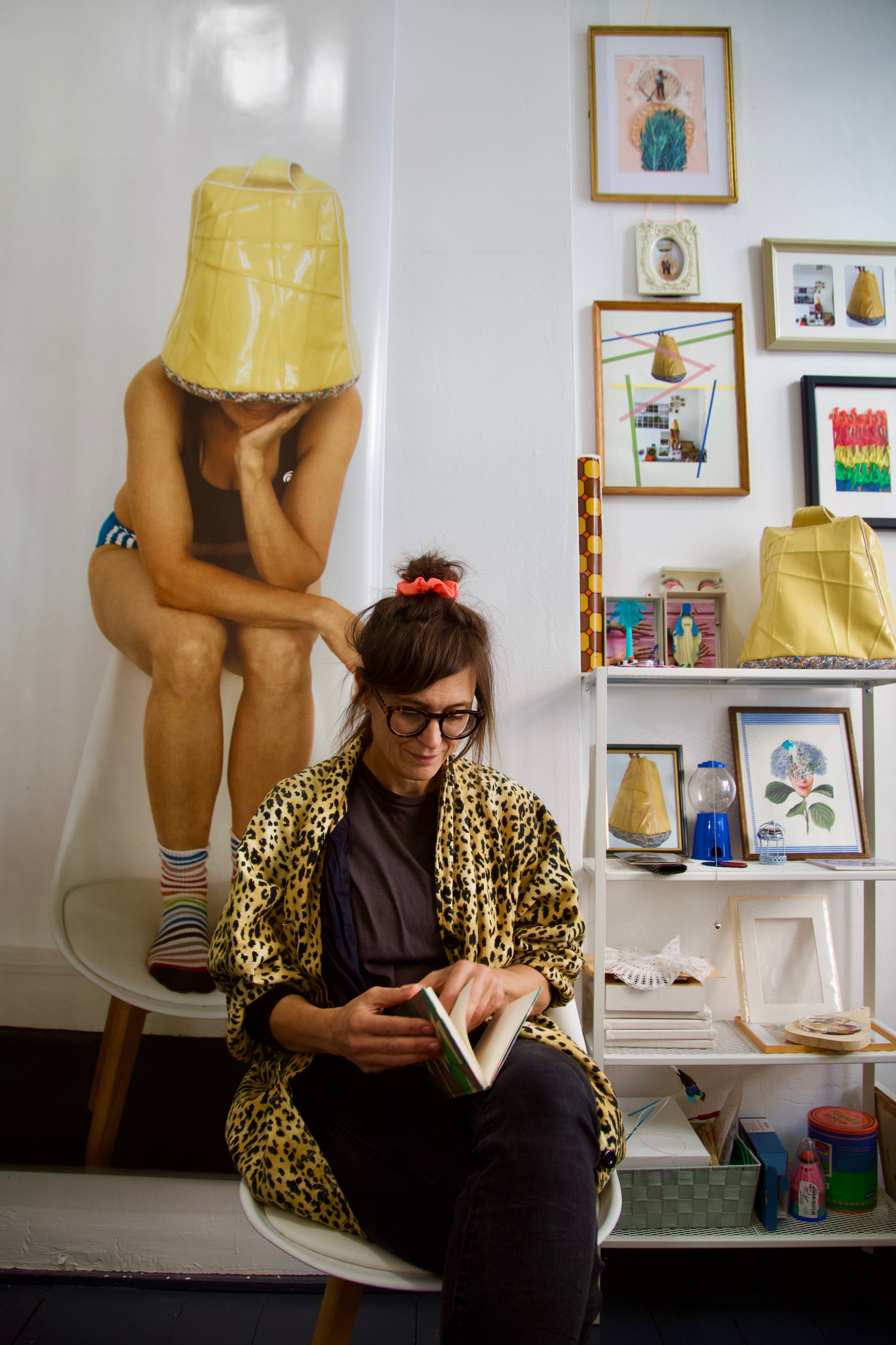
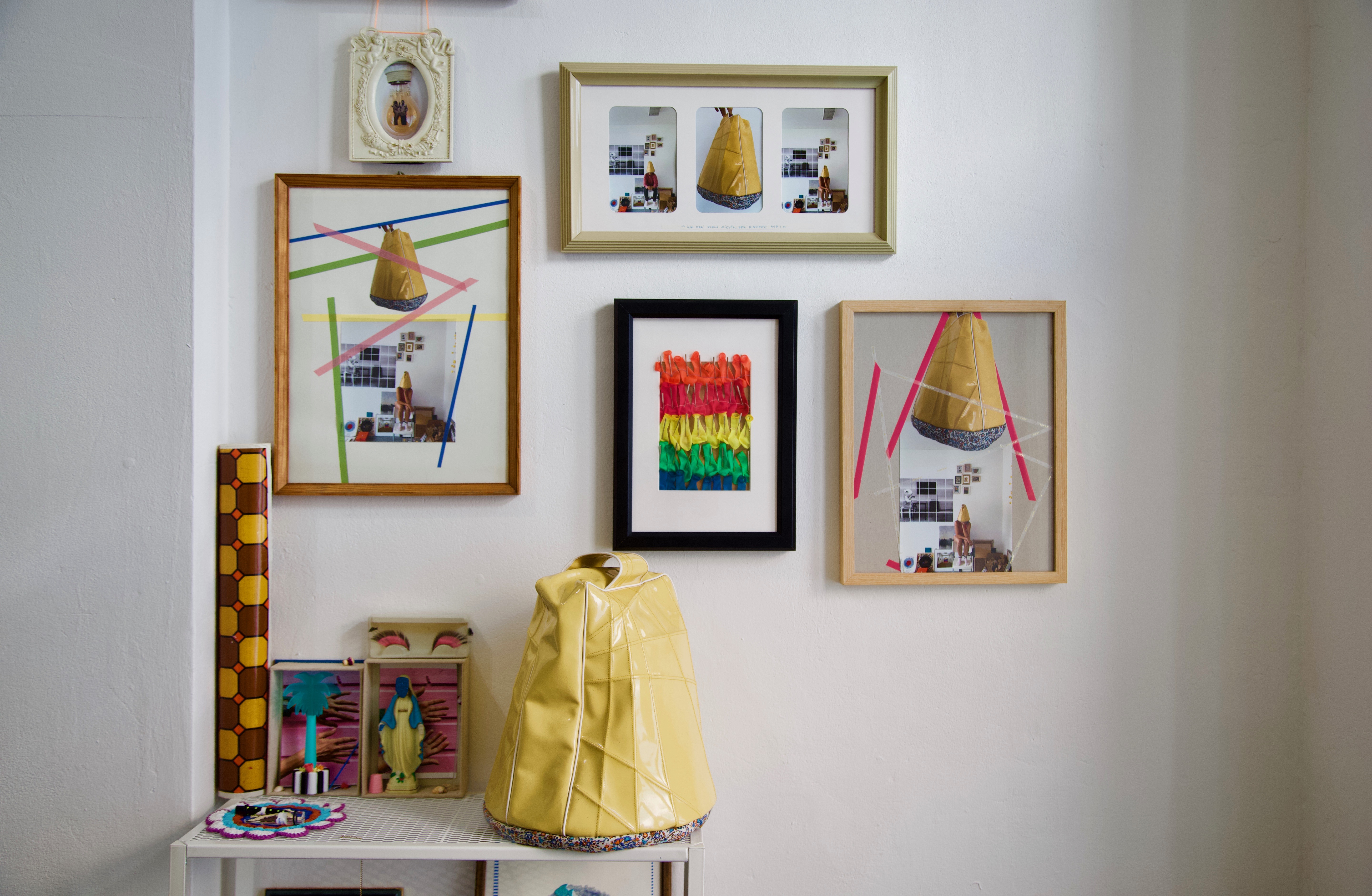
A lampshade instead of a face. Rainbow socks on a white chair. Grandmother’s tablecloths slashed with red crosses. Petra Gregorovic, also known as Elle-p, works across collage, installation and performance, and her work is anything but modest. It is strong, sharp and deeply ironic. Her practice draws on two worlds at once: classical culture, with its painted surfaces, devotional objects and ornamental patterns, and the alternative scene culture of the 90s and 2000s, with its DIY spirit, humour and refusal to behave. Out of this collision comes a visual language that is playful on the surface and political underneath. Take the lampshade. Worn over the head in her large-scale self-portraits and shown as an object in its own right, it turns the artist into furniture, a decorative thing in a domestic interior. It is funny, and then it isn’t. The same goes for the vintage tablecloths she paints over: symbols of household order and inherited femininity, crossed out and rewritten in bold strokes. Her current series, Collaged Performances, brings it all together: selfie fragments, drawings, found objects and ready-mades, nineteen pieces hung salon style and activated by her own performance. Every piece carries a clear feminist position, but never as a slogan. Irony is her method. She takes what women are expected to be, softens it, decorates it, exaggerates it, and hands it back to us so we finally see it. In her own words: “My idea is to show what we actually have today in order to put it into a positive mood for what is awaiting tomorrow.”
INTERVIEW
You work across music, video, singing, performance, installation, and collage. Do you think of these as separate practices, or one continuous language?
I view them as a single, continuous language. They are simply different tools, timbres, or gestures used to convey the same core concepts. Whether I’m building a rhythmic structure with my voice or arranging physical materials in a space — the underlying aspiration remains the same: to explore emotions, memory, and presence. I find inspiration across these disciplines, they multiply, and choose them as if from a large toolbox. For example, the spatial and temporal aspects of an installation significantly influence how I shape the tempo of my music and structure it. Conversely, the textures of my singing often determine the visual elements in my installations or help to put them in a feeling that I want them to be seen. In all that, I don’t feel the urge for perfection; for me, it’s primarily about creating moods and inviting the spectator to hop on a journey through my imaginary archive.
Tell us about “Collaged Performances.” What made you want to revisit past performances through collage rather than photography or video alone?
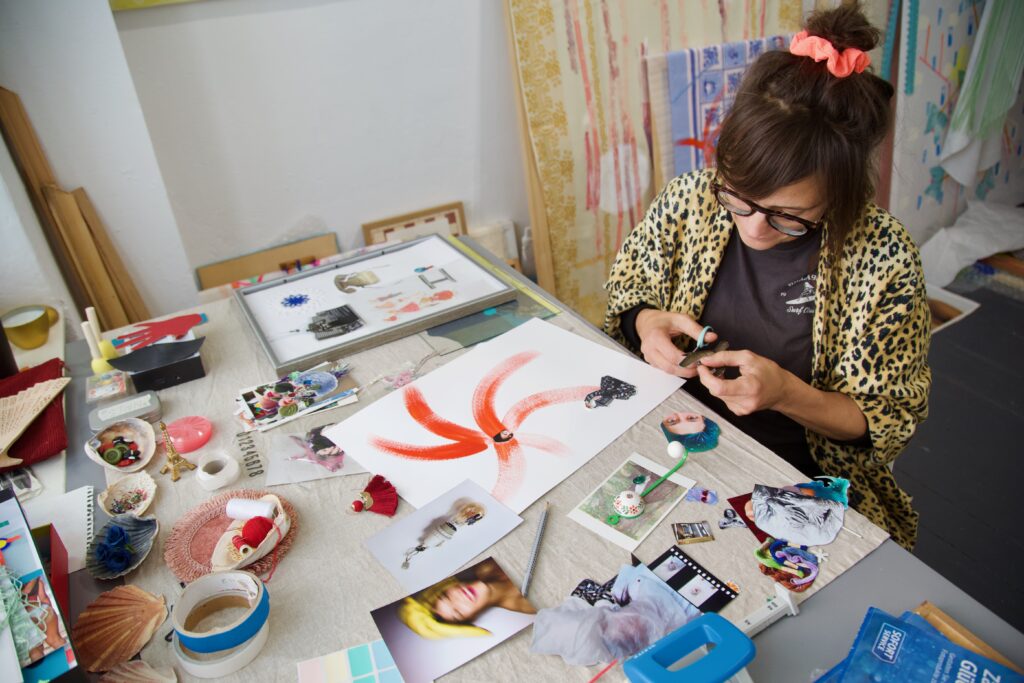
Multifeel, haptic, best way for me to recreating the work situation where I am surrounded by my material collection, sitting in a room surrounded by stuff; life consists of making choices the whole time.
You mentioned “Collaged Performances” could be a starting point for a working dialogue here, but a new project is also possible. Which way are you currently leaning?
When I applied to the art academy, I applied with my paintings, but after being accepted, I didn’t really pursue it and switched to a sculpture and a new media class. After all these years of exploring and discovering other disciplines, I’m once again very interested in refocusing on painting. I’m currently experimenting a lot with different textiles and ways of applying paint. I’ve always had a good sense of color choice and composition, which helps.
Is there something about ARTLAB_LCC, the space, Neukölln, the other artists, that’s already influencing the direction?
It’s a big advantage at first to be able to discuss my work with Luisa right away and to be in dialogue with her from the very beginning about whether a piece is heading towards an interesting direction or if it’s crap. Neukölln was never really my preferred hood although I did live close and my friends lived there, so I don’t have the urge to explore this part of the city for inspiration or new moods. The atmosphere in the ArtLab is lovely, which makes it easy to feel comfortable there.
What does “boring domestic work” reveal when you put it inside a performance or a collage that it wouldn’t reveal on its own?
The viewer immediately has to overcome the traditional undertone domestic work brings into it. Opponing domestic work to the collages means in a way to put them at risk, playing with the taste of being a “hobby”.
What’s one question about your work you wish people asked more often?
Is it for sale?
SELECTED EXHIBITIONS
Her selected exhibitions include Cymatics at Spartacus, Potsdam (2025), Digitalanalog in Munich (2021), The Lovelace in Munich (2019), Lost Art Festival in Berlin (2017), Millerntor Gallery in Hamburg (2016), Unpainted Media Art Fair in Munich and Berlin Art Week (2014), Digital Art & Sound / Transmediale in Berlin (2012), Supalife Kiosk in Berlin (2011), Pudel Club in Hamburg (2007), and Städtische Galerie im Lenbachhaus in Munich, Cernusco sul Naviglio in Milan, and Kunstverein Würzburg (2005). From 2011 to 2015, she was also associated with Anna Jill Lüpertz Gallery in Berlin.